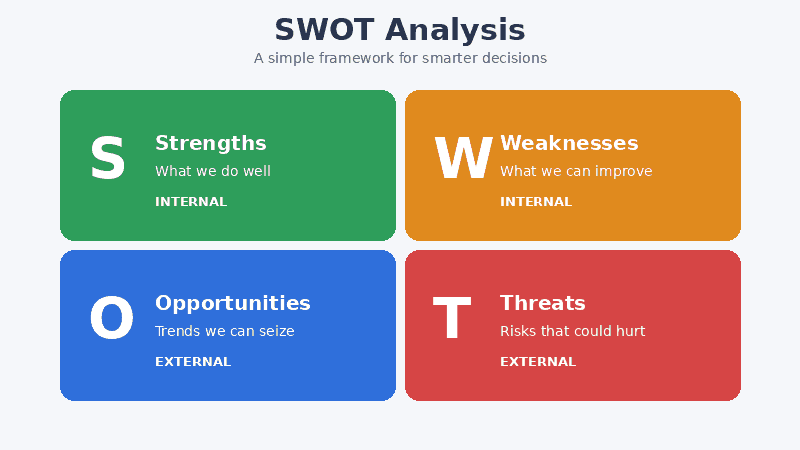
Every good decision starts with an honest look at where you stand. Should you launch a new product, enter a new market, or change careers? You can’t answer any of these well without knowing what you have going for you and what stands in your way.
That’s the job of a SWOT analysis. It’s one of the most widely used planning tools in business, and it’s simple enough to sketch on a whiteboard in an afternoon. This guide covers what it is, where it came from, how to run one, and where it falls short.
What Is a SWOT Analysis?
A SWOT analysis is a decision-making technique that identifies the strengths, weaknesses, opportunities, and threats of an organization, project, or person. It’s usually done early in planning, to show your strategic position before you commit time and money.
The results are normally laid out in a 2×2 grid called a SWOT matrix. One axis separates internal factors from external ones, and the other separates helpful factors from harmful ones.
What Does SWOT Stand For?
| Letter | Meaning | Where it comes from | Nature |
|---|---|---|---|
| S | Strengths | Inside the organization | Helpful |
| W | Weaknesses | Inside the organization | Harmful |
| O | Opportunities | Outside the organization | Helpful |
| T | Threats | Outside the organization | Harmful |
The internal versus external split is the most important idea in the framework. You can change strengths and weaknesses because they belong to you. You can’t control opportunities and threats, but you can decide how to respond to them.
The Four Components Explained
Strengths
Strengths are the things you do well or the advantages you have over others. Think of skilled people, a trusted brand, low costs, useful technology, or a loyal customer base.
A strength only counts if it gives you a real edge. If every competitor also makes high-quality products, quality isn’t a strength in your market. It’s the minimum requirement to compete.
Questions to ask:
- What do we do better than anyone else?
- What do customers say they like about us?
- What resources can we use that others can’t?
Weaknesses
Weaknesses are internal factors that put you at a disadvantage: thin resources, outdated systems, skill gaps, unreliable cash flow, or a weak reputation.
This is the quadrant where teams tend to go easy on themselves. Ask customers and colleagues what they experience, because outsiders often see problems you’ve stopped noticing.
Opportunities
Opportunities are external chances you could take advantage of. They might be a growing market, a technology shift, a favorable policy change, a gap competitors have left open, or changes in how people live and buy.
Opportunities don’t need to be dramatic. Small advantages can improve your position, and they don’t help unless you act on them.
Threats
Threats are outside forces that could hurt you: new competitors, economic downturns, supply-chain problems, tougher regulation, changing customer expectations, or fast-moving technology.
Weaknesses often make threats worse. A business with shaky cash flow is far more exposed to a small market shift than one with healthy reserves.
A Brief History of SWOT
The origins of SWOT are debated. Many sources credit Albert Humphrey, but researchers have also pointed to a 1960s team at Stanford Research Institute. They used a similar framework called SOFT (Satisfactory, Opportunities, Faults, Threats). Harvard Business School professors also published closely related ideas around the same time.
By the early 1970s the acronym SWOT was appearing in print, and by the 1980s the 2×2 matrix format was common. It remains a staple of business textbooks and planning meetings.
SWOT Analysis Example
Here’s a simple example for a small start-up consultancy planning its growth.
| Helpful | Harmful | |
|---|---|---|
| Internal | Strengths: Fast decisions with no red tape; strong reputation of the lead consultant; low overheads that allow competitive pricing; plenty of time for customer care | Weaknesses: Little market presence; small team with a shallow skills base; heavy dependence on a few key people; unreliable early cash flow |
| External | Opportunities: A growing business sector; local government support for local businesses; competitors slow to adopt new technology | Threats: Technology changes that could reshape the market; a large competitor shifting focus into the same niche |
Reading across the grid, the pattern is clear. The firm’s agility and low costs make it well suited to rapid-response services for local businesses. Its size is also its biggest weakness, so it needs to invest in training and staff retention. It should watch technology trends and large competitors closely, and put its limited marketing budget into a few targeted industry channels.
How to Do a SWOT Analysis: Step by Step
Step 1: Define your objective. SWOT works best when it’s pointed at something specific, such as a product line, a project, or a market decision. A vague “whole company” analysis produces vague results.
Step 2: Gather the right people. Don’t rely on one person’s view. Bring in people from different departments and levels, and consider input from customers. Small breakout groups of about three to ten people keep everyone participating.
Step 3: Brainstorm each quadrant. Give groups 20 to 30 minutes to generate as many ideas as possible without filtering. Use the guiding questions above, and try filling in the quadrants in a different order to shake loose new thinking.
Step 4: Sort internal from external. A common mistake is putting an outside factor (like a competitor’s new product) under weaknesses. If you can’t directly change it, it belongs on the external side.
Step 5: Refine and be specific. Trim each list to your best ten or fewer points and replace vague statements with verifiable ones. “Better value” tells you nothing, while “$30 per ton cost advantage in raw materials” gives you something to plan around.
Step 6: Connect the quadrants. Look for links between them: which strengths could capture which opportunities, which weaknesses leave you exposed to which threats. The TOWS matrix formalizes this into four strategy types:
- SO (strengths + opportunities): use what you’re good at to seize openings.
- WO (weaknesses + opportunities): fix weaknesses by taking advantage of openings.
- ST (strengths + threats): use your strengths to defend against threats.
- WT (weaknesses + threats): reduce weaknesses and avoid threats, a defensive position.
Step 7: Prioritize and act. Rank the opportunities and risks, assign owners and deadlines, and fold the results into a real plan. A SWOT that ends as a list on a slide has failed.
Who Can Use a SWOT Analysis?
SWOT began in business but has spread well beyond it:
- Businesses and start-ups use it for strategy, product launches, and competitor profiling.
- Nonprofits and community groups use it to assess programs and plan change, with input from the people they serve.
- Governments and regional planners use it to assess local economies. U.S. federal guidance on regional economic development strategies asks planners to run a SWOT covering assets, competitive position, and economic resilience.
- Individuals use a personal SWOT to plan careers and skill development.
- Project teams use it before launches or major changes, to spot readiness gaps and risks.
Benefits of SWOT Analysis
- It’s simple and cheap. You need a grid, some people, and an afternoon.
- It challenges assumptions. Writing strengths next to weaknesses and threats can show that something you relied on is less solid than you thought.
- It links inside and outside. Many planning tools look at only one of the two.
- It’s flexible. It works at company, product, project, or personal level.
- It sparks useful discussion. The conversation is often as valuable as the finished grid.
Common SWOT Mistakes to Avoid
- Being vague. Generic points lead to generic strategy.
- Relying on opinion instead of evidence. Back claims with data, customer feedback, or concrete examples.
- Mixing internal and external factors. This muddles which items you can control.
- Making the lists too long. Ten strong points beat forty weak ones.
- Ignoring weaknesses. Overconfidence is the most common failure.
- Planning around opportunities that don’t exist yet. A market that might open in five years isn’t a plan.
- Letting one or two voices dominate. Quiet team members often hold the most useful observations.
- Doing it once and filing it away. Conditions change, so revisit the analysis regularly.
- Stopping before the action plan. This is the biggest failure of all. Critics of SWOT have long pointed out that its output often goes unused in later planning.
Limitations of SWOT and Alternatives
SWOT is a starting point, not a complete strategy. Critics note that it’s a snapshot of the present, that personal bias can shape what makes the list, and that it doesn’t tell you how to gain a competitive advantage. It can also encourage a “fit” mindset, matching what you already do to what’s out there, rather than stretching toward something new.
Pairing it with other tools helps:
- PEST analysis to examine political, economic, social, and technological forces.
- TOWS matrix to turn SWOT findings into strategies.
- Porter’s Five Forces for a more rigorous view of industry competition.
- SOAR (Strengths, Opportunities, Aspirations, Results), a more forward-looking, positive variant.
Frequently Asked Questions
What is a SWOT analysis in simple words?
It’s a way to list what you’re good at, where you’re weak, what chances are available, and what risks you face, so you can plan with a clear picture.
Are strengths and weaknesses internal or external?
Internal. Opportunities and threats are external.
When should I do a SWOT analysis?
Before a major decision or change, when launching a new initiative, when looking for growth areas, or when you need to adjust a plan that isn’t working.
How often should I update it?
At least once a year, and whenever something significant changes in your market or organization.
Can I do a SWOT analysis for myself?
Yes. A personal SWOT looks at your skills, habits, and network alongside career trends and risks in your field.
Who invented SWOT analysis?
The credit is disputed. Albert Humphrey is often named, but researchers have also traced the roots to Stanford Research Institute’s SOFT approach in the 1960s.
Conclusion
A SWOT analysis won’t make decisions for you, but it does force an honest look at your situation, both inside and out. Keep it specific and evidence-based, involve more than one perspective, and finish by turning insights into actions. Then revisit it as conditions change.